


 Written by admin
Have you ever wondered what all the information means when choosing Streaming Links in Streaming Apps & APKs?
This is a question we receive often at TROYPOINT, and this guide will help explain what everything means when selecting a link to play.
Using popular media applications such as Stremio, Nuvio, and Kodi are fabulous methods to stream Video on Demand without a subscription.
However, it can oftentimes be difficult to decide which link to play after making a content selection.
Most links or sources are accompanied by text and numbers that can be confusing if you don’t know what they mean.
This guide will explain streaming links and help you decide which link is best for you based on your streaming device, internet speed, and more.
We will break down what you see when you choose a Movie or TV Show in popular APKs such as Stremio & Nuvio.
Most APKs and Kodi Addons use the source-select option to play Movies and TV Shows. Usually, this is the default setting and the best way to find a source for streaming.
This means that you are provided with multiple links to choose from after making a content selection. But what are the differences in each link?
In this example, we will use Stremio to show you how to choose the best link after you are presented with numerous options.
Because Stremio must be configured with 3rd Party Addons to curate content choices, you will likely have a few different selections to choose from.
If you are a Premium Debrid user (which we strongly suggest), you will probably have more options presented to you, and the quality will definitely be better.
If you have set up Stremio properly, you will likely be presented with a screen similar to what you see below after choosing your film or series.
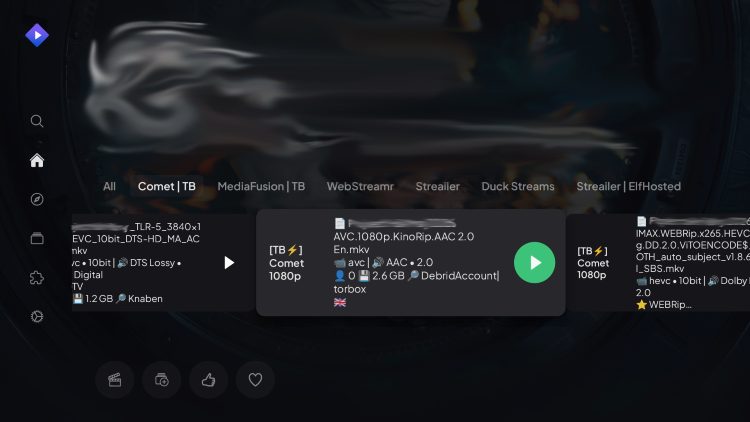
This is where you will see the streaming links presented. If you are unfamiliar with what all of this information means, we will break it down for you.
The first thing you will want to recognize is the file size associated with each link. These can vary immensely and may be the biggest factor in deciding which link is best.
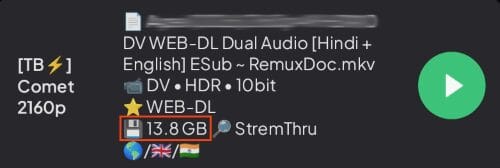
File sizes typically range from 500 MB for low-quality streams all the way up to 80+ GB for high-bitrate 4K remux files. Here are some general guidelines:
Smaller files (under 2 GB)
Mid-size files (2–10 GB)
Large files (10–40+ GB)
Rule of thumb: Bigger file size usually equals better quality, but also higher bandwidth required.
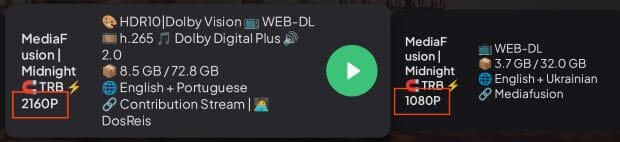
The resolution refers to the quality of the video that will play. The number you see refers to the number of pixels displayed on your screen, which directly impacts how sharp and detailed the video looks.
Standard options typically include 2160p (4K), 1080p, and 720p.
Other formats you may see include DVDscr (DVD-Screener), which is a pre-release of the video sent to reviewers and others. This is usually not the greatest quality but oftentimes plays in 720p.
CAM is also a popular video file, but these are almost always of terrible quality. These files are typically theater rips that movie pirates acquire by filming the movie in theaters.
The “source” tells you where the streaming link is coming from. This plays a major role in reliability, buffering, and speed.
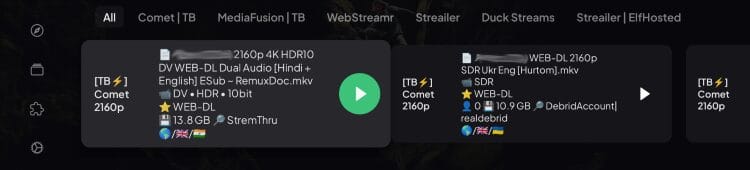
When you choose a Movie or TV Show in one of these APKs, you will likely come across numerous different source outlets.
If you subscribe to a premium debrid service such as TorBox, you will see them labeled as DEB or TB, depending on which platform you use.
These indicate cached files stored on high-speed servers, which typically provide the fastest and most reliable streaming experience.
Torrent (P2P)
Cached Torrent (Debrid Services)
File Lockers / Direct Links
HTTP Streams / CDN Sources
IMPORTANT NOTE: If you choose to use torrent files for streaming, you must make sure you are also using a VPN. Without one, you are exposing your IP address to onlookers and more. Be sure to protect yourself.
Audio labels tell you what type of sound format the file uses, which can impact both quality and compatibility.
Common audio formats include:
If you’re using TV speakers or a basic setup, AAC or AC3 is fine. For home theater setups, look for DTS, TrueHD, or Atmos.
Your internet speed plays a major role in which file sizes you can stream without buffering. This is one of the most important factors to consider when choosing a streaming link.
For best results, you should run a Speed Test on your device to determine your download speeds. This will give you a much more accurate idea of what speeds you’re actually working with.
Here’s a general guideline:
It is important to point out that stability matters just as much as speed. A consistent connection is key, and even if you have strong download speeds, you may experience buffering when playing large files.
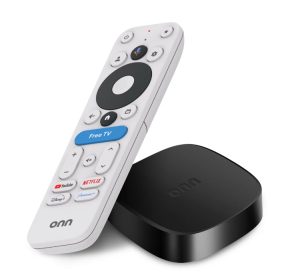
Yes, the type of streaming device you use plays a role in determining the links that you can access. While this is important, it is less of a factor than things like file size and your network speed.
RAM affects how well your streaming app runs in the background and how efficiently it can handle buffering, caching, and playback.
2 GB RAM (Fire TV Stick, Onn 4K Plus, MECOOL KM7)
Devices like the Amazon Fire TV Stick 4K typically come with around 2 GB of RAM. This is enough for most users and will handle the majority of streaming links without issues.
However, when you start playing large files (15–40 GB+) or high-bitrate 4K content, you may notice:
3–4 GB+ RAM (NVIDIA SHIELD, Onn 4K Pro, Google TV Streamer)
More powerful devices like the NVIDIA Shield TV Pro include 3 GB or more RAM, which allows for:
When you select a streaming link, especially a large one, your device has to buffer data, decode the video/audio, and render it in real time. More RAM helps keep everything running smoothly during this process.
That said, RAM is just one piece of the puzzle. Even with lower RAM, you can still stream high-quality content if your network speed is fast/stable and you choose reasonably sized files.
Keep in mind that if your device only supports 1080p resolution, you won’t be able to stream videos that are higher quality than this.
Once you have a general idea of your connection speed, you can begin choosing links that fall within your ideal file size range to avoid buffering and playback issues.
From there, look for links that are labeled with high-quality sources such as WEB-DL or Blu-ray, as these typically provide the best viewing experience.
If available, always prioritize links that are cached or come from your Debrid Provider. These will load much faster and are already stored on the service’s server, which means faster playback and minimal buffering.
You should also pay attention to the resolution, ensuring it matches both your device capabilities and internet speed. For example, selecting a 4K (2160p) file on a slower connection may result in constant buffering, even if the quality is higher.
Additionally, consider the file size vs. quality balance. While larger files often provide better picture and audio, they are not always necessary—especially for smaller screens or casual viewing.
In most cases, a mid-sized 1080p file will offer the best combination of quality, speed, and reliability for the average user.
Let us know what you look for when browsing links in the comments below!
This page includes affiliate links where TROYPOINT may receive a commission at no extra cost to you. Many times, visitors will receive a discount due to the special arrangements made for our fans. Learn more on my Affiliate Disclaimer page.



© IPTVSub is Proudly Owned by win-design